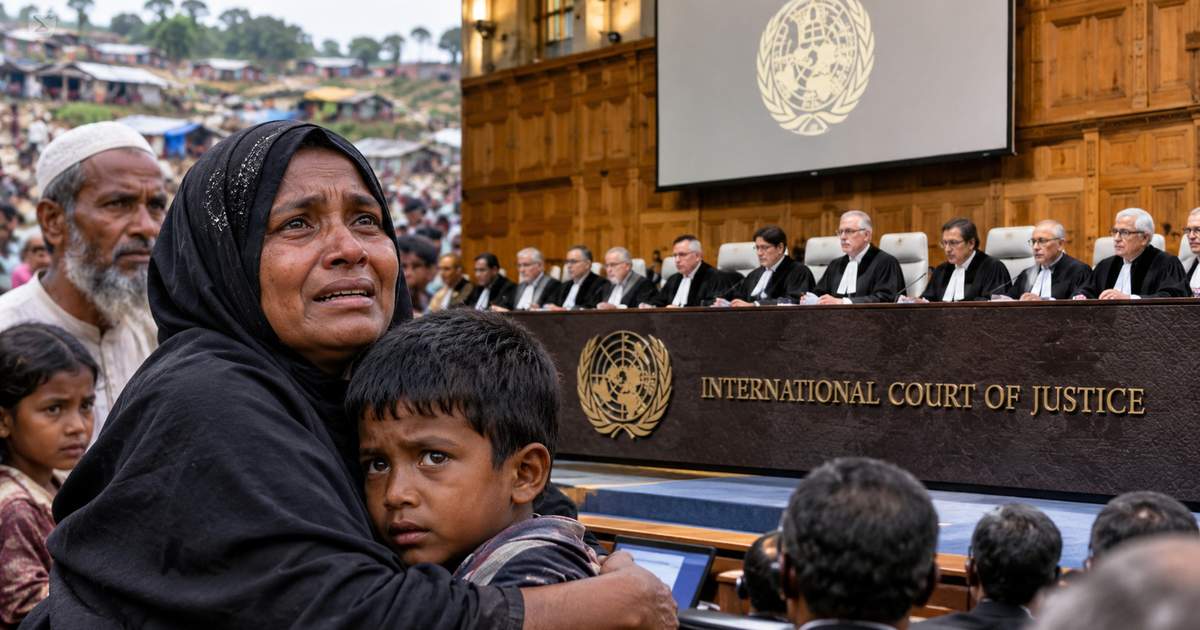
In the refugee camps of Cox’s Bazar, Bangladesh, people crowded around a big screen to watch a courtroom in The Hague. Many of them had waited nine years to hear what the judges would say.
The Myanmar Rohingya genocide ruling is now part of international law. On November 19, 2026, the International Court of Justice (ICJ) found, by 9 votes to 6, that Myanmar committed genocide against the Rohingya in northern Rakhine state. It is the first time the court has found a state responsible for committing genocide.
Here is what the court said, why it took so long, and what it does and does not change.
What did the ICJ decide?
The judges found that Myanmar broke the 1948 Genocide Convention. The details are hard to read. According to the court’s president, Yuji Iwasawa, state security forces killed roughly 10,000 Rohingya, carried out widespread sexual violence, committed extreme violence against children, and attacked people as they fled toward Bangladesh.
The hardest part of any genocide case is proving intent: showing that a state meant to destroy a people, not only that terrible things happened. The court concluded that the only reasonable reading of the evidence was an intent to destroy a substantial part of the Rohingya. It also held that Myanmar failed in its separate duty to prevent genocide.
For the case file and background, see the UN Independent Investigative Mechanism for Myanmar.
Background: how the Rohingya crisis began
The Rohingya are a mostly Muslim minority in Buddhist-majority Myanmar. In 2017, a military offensive pushed at least 730,000 of them across the border into Bangladesh. Myanmar has long said its operations were a response to attacks on police posts by the Arakan Rohingya Salvation Army. The judges did not accept that this explained what was done to civilians.
For a fuller timeline, read our explainer on the Rohingya crisis.
Why did the case reach the world’s top court?
The Rohingya have no state of their own to sue on their behalf, so a small West African country stepped in. The Gambia filed the case in November 2019 with the backing of the Organization of Islamic Cooperation.
The ICJ only hears disputes between states, and Myanmar argued The Gambia had no right to bring the case. In 2022 the court disagreed, ruling that The Gambia, as a party to the Genocide Convention, could hold Myanmar to account. You can read the 2022 judgment on the ICJ website.
- 2019: The Gambia files the case.
- January 2020: The court orders Myanmar to take all measures within its power to prevent genocidal acts.
- 2022: Myanmar’s objections to the court’s jurisdiction are rejected.
- January 2026: After final hearings, the judges begin deliberating.
- November 19, 2026: The verdict is delivered.
New to how the court works? Read what the ICJ is and what it can do.
Myanmar’s response and international reaction
At the January hearings, Myanmar’s representative Ko Ko Hlaing defended the crackdown as a response to insurgent attacks. At the time of writing, a formal government statement on the verdict was not yet available in the sources reviewed, so this section will be updated as Myanmar responds.
Reaction elsewhere was quick:
- The Gambia called it a historic day for international justice and urged Myanmar to comply fully and without delay.
- The United Kingdom said it would order the expulsion of Myanmar’s defense attaché.
- Human Rights Watch described the verdict as long-awaited recognition of the Rohingya’s suffering. Its questions and answers on the judgment explain the legal points clearly.
There is an uncomfortable irony here. Min Aung Hlaing, who led the military during the 2017 crackdown, is now Myanmar’s president.
What happens next for Rohingya refugees?
The court ordered real remedies. Myanmar must provide restitution, or compensation where restitution is impossible, and The Gambia may seek reparations on the victims’ behalf. The orders include safe and voluntary return, replacing damaged collective property, and proper burials for the dead. Myanmar has two years to report back to the court on what it has done.
That last point matters on a human level. One survivor, Mohammed Osman, said he hopes to return home to perform last rites for his parents and younger brother, whom he says the army killed.
But a ruling is not a plan. Three problems stand in the way:
- Enforcement is weak. The judgment is final, but the court has very limited means of enforcing it. If Myanmar ignores it, The Gambia could ask the UN Security Council to act.
- Rakhine is contested. Most of the land the Rohingya fled is now held by the Arakan Army, an ethnic Rakhine armed group fighting the military.
- The camps are under strain. Nearly 1.2 million Rohingya remain in refugee camps in Bangladesh, where funding cuts have reduced food rations.
Richard Horsey of the International Crisis Group said the ruling will not change Rohingya lives quickly, but it puts what was done to them on the legal record. For more, read Radio Free Asia’s report and Al Jazeera’s coverage.
Why this decision matters for international law
It sets a record. A court of the highest standing has now said, on the evidence, what survivors have said for years.
It widens who can sue. The court accepted that The Gambia could seek reparations for victims it has no direct tie to, which other states may take note of. The EJIL: Talk analysis covers the reasoning in depth.
It will be watched elsewhere. Legal scholars are expected to look in the reasoning for guidance relevant to South Africa’s 2023 case accusing Israel of genocide in Gaza, an allegation Israel rejects. The ruling does not decide that case. See our piece on the South Africa v. Israel case.
The 9–6 split is a reminder that genocide is among the hardest findings in law to reach. Now a court has reached it. What follows depends on whether governments are willing to act.
Frequently asked questions
Did the ICJ find Myanmar guilty of genocide?
Yes. By 9 votes to 6, it found Myanmar committed genocide against the Rohingya. Technically, the ICJ judges states, not individuals, so the finding is one of state responsibility.
Can Myanmar appeal the ruling?
No. The judgment is final and cannot be appealed.
Can the ICJ enforce the ruling?
Not directly. Enforcement depends on the UN Security Council and on diplomatic pressure from other governments.
How many Rohingya live in refugee camps?
About 1.2 million, in camps in Bangladesh.