
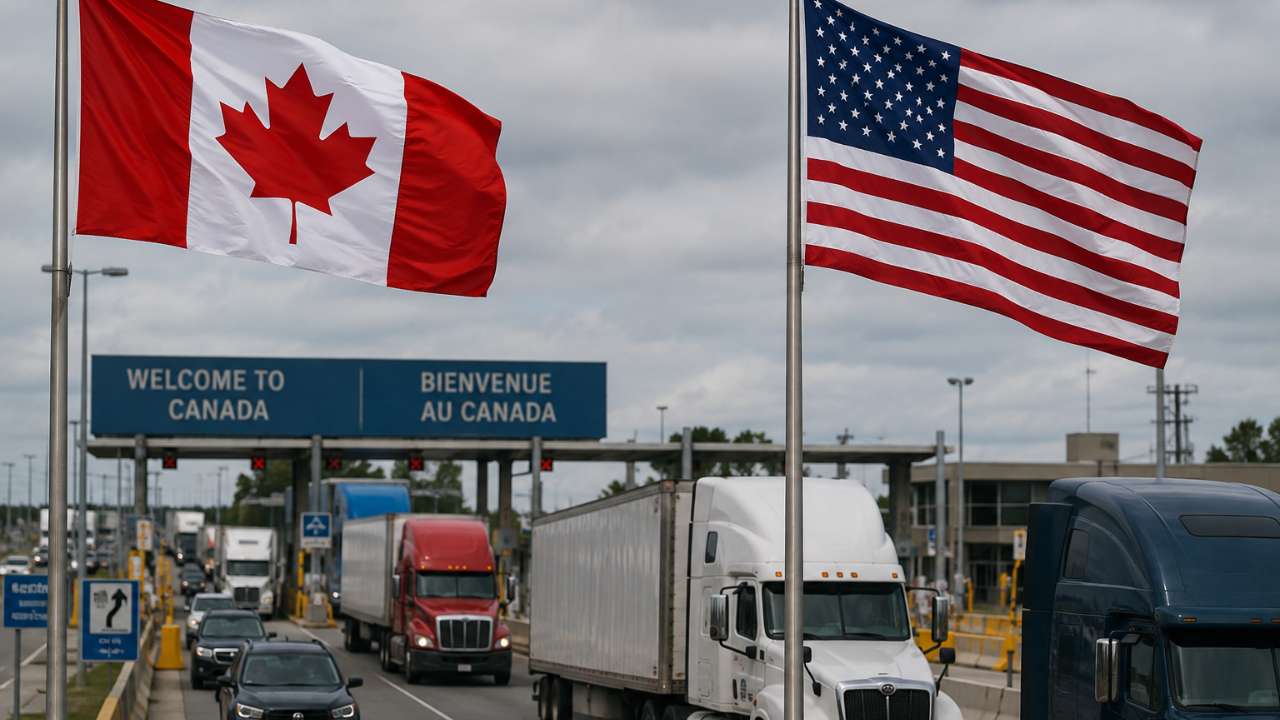
The long-running US-Canada Trade tensions between the United States and Canada have entered a new phase. Canada has announced that it will impose retaliatory tariffs of an equivalent value on American goods in response to the new tariffs imposed by US President Donald Trump’s administration on various goods imported from Canada.
Canadian Prime Minister Mark Carney has said that Canada will respond to Washington’s new tariffs “dollar for dollar,” i.e., the equivalent value of the US move, after intensive US-Canada Trade talks between the United States and Canada in recent days have failed to reach an agreement. Canada’s retaliatory tariffs are expected to take effect on September 8, 2026.
The latest US-Canada Trade dispute has further strained relations between the two neighbors and allies, who have been deeply intertwined economically for decades. The escalation of the US-Canada Trade conflict could also affect cross-border trade, businesses, supply chains, jobs, and consumer prices in both countries.
Trade relations between the United States and Canada
The US-Canada trade relationship is considered the backbone of the North American economy. But President Trump’s protectionist trade policies have recently put serious pressure on this relationship.
US and Canadian officials held three days of intense trade talks in the last phase. Although both sides tried to reach a new trade agreement, no agreement could be reached by Friday night.
Canadian Prime Minister Carney accused the US of adding new and unacceptable conditions to its proposals in the final phase of the talks. Carney had said that the latest proposals from the US side were economically disadvantageous, unfair and would undermine the basis for a possible agreement in Canada’s interests.
He then suspended the talks and instructed the Canadian negotiating team to return to Ottawa. He said that Canada was not ready to compromise at any cost and would prioritize the country’s economic interests and sovereignty.
US Trade Representative Jamieson Grier said that the failure of the talks was a missed opportunity for Canada. According to him, the US side claims that Ottawa did not accept it even though the US gave Canada the opportunity to negotiate. The US side has also stated that there are no immediate plans for new talks.
On which items will the new fee be applied and equally?
The new tariffs imposed by the Trump administration will not apply equally to all goods from Canada to the US. The new 50 percent tariff focuses on various Canadian products.
Under this, Canadian exports to the US, including wine, furniture, dairy products, cement, clothing, fishing equipment and hockey equipment, have been affected. International reports have said that the new US tariffs will affect Canadian exports worth about $20 billion.
The US government has justified the new tariffs on Canadian goods with its trade and economic interests. However, Canada has described these tariffs as unfair pressure.
Prime Minister Carney has said that Canada will protect its industries, workers, farmers and businesses in the face of the US measures. After the US tariffs were implemented, Canada has also decided to impose retaliatory tariffs.
According to Prime Minister Carney, Canada will impose tariffs on steel, dairy products, household appliances, agricultural equipment, pulp and paper and electronics imported from the US. The Canadian government says that this is aimed at protecting Canadian industries and workers who will be affected by the US measures.
The Canadian government has presented its retaliatory measures as a policy of imposing retaliatory tariffs “dollar for dollar,” i.e., the same amount as the U.S. tariffs. However, the Canadian government has said that it will release more details about the full details and the rates for each product.
Canada’s decision has the potential to deepen the trade dispute between the two countries. The United States has also indicated that it may take additional tariffs or other trade measures in response to Canada’s retaliation.
The risk that the dispute between the United States and Canada will no longer be limited to tariffs on a few goods has increased. If both sides continue to increase tariffs on each other’s products, the impact could reach into industry, jobs, consumer prices, and investment.
This challenge is even more serious for Canada.
This challenge is even more serious for Canada, because a large portion of its exports depend on the US market. About 70 percent of Canada’s total exports go to the US.
In such a situation, additional tariffs on the US market risk increasing costs for Canadian industry, weakening the competitiveness of products, and putting pressure on jobs in some sectors.
But the Canadian government is also pursuing a strategy to reduce excessive dependence on the US market. Prime Minister Carney has prioritized a strategy to expand exports to markets outside the US and diversify international trade partnerships.
The trade regime for large vehicles was one of the main points of contention in recent talks between the US and Canada. Canada demanded that the proposed preferential tariff regime for light vehicles also be applied to medium and heavy trucks. But the US side could not agree to this.
According to the Canadian side, accepting the US proposal could weaken the competitive position of some popular trucks manufactured in Canada.
Since the automobile industry is an important part of US-Canada trade, an increase in tariffs in this area could affect the production chains of both countries.
In this sense, the recent developments between the US and Canada have become a much bigger issue than just a simple trade dispute between the two countries.
Relations between the United States and Canada
The relationship between the United States and Canada has historically been one of the closest and most comfortable in the world. The border between the two countries is the longest demilitarized border in the world, and has served as a symbol of free movement, deep cultural and family ties, and an unbreakable trade partnership for decades.
The United States-Mexico-Canada Agreement, which came into effect after NAFTA, institutionalized unhindered trade between the three countries. Canada remains one of the United States’ largest trading partners. The two countries are also close allies in security, NATO cooperation, and the economy.
But in 2025, the relationship began to fray when President Donald Trump announced sweeping tariffs on Canadian goods. Most imports were subject to 25 percent tariffs and energy products were subject to 10 percent tariffs.
Canada responded by imposing retaliatory tariffs on $30 billion worth of U.S. goods, which rose to $155 billion within three weeks.
Then, the long history of trust and cooperation between the two countries suddenly turned into a tense rivalry. Meanwhile, relations between the two countries have become more bitter after Trump announced that Canada would become the ‘51st state’ of the United States.
The latest trade dispute and new retaliatory tariffs have further complicated relations between the United States and Canada. It seems that the trade policies adopted by both countries in the coming days could affect not only bilateral trade, but also North American production chains, industries, jobs and consumer markets.