Company Evergrande Group
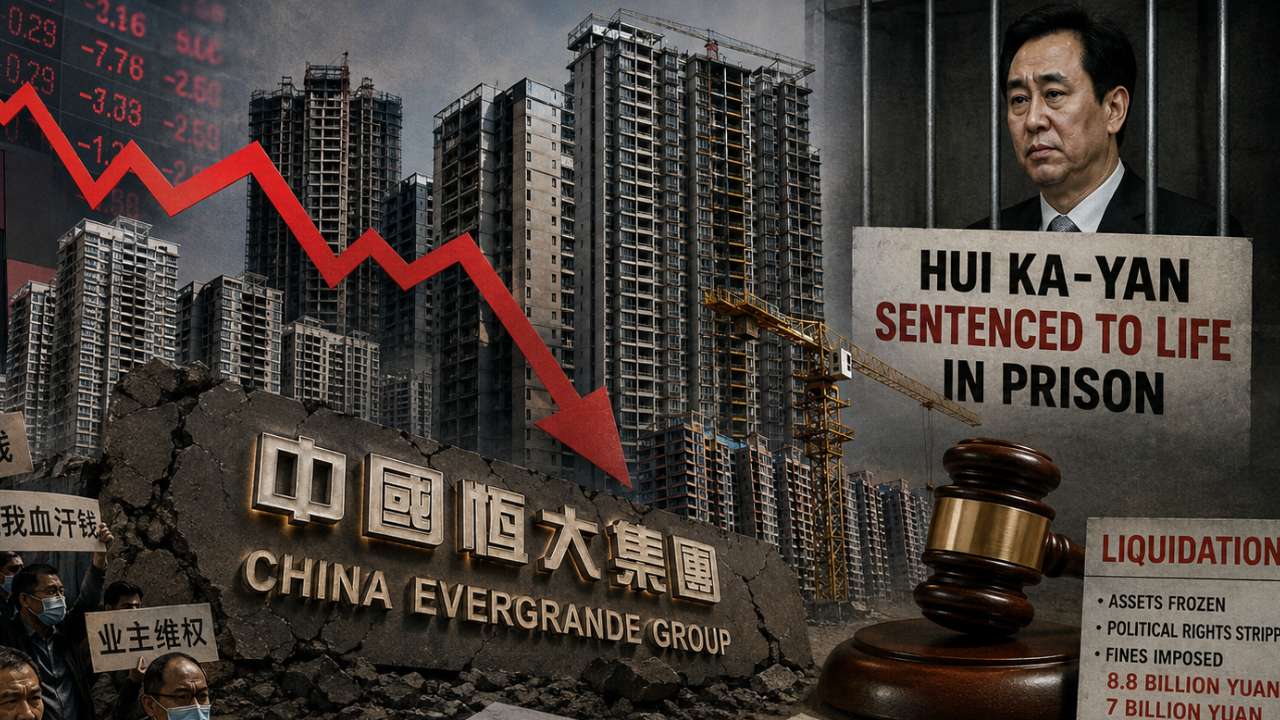
China’s giant real estate company Evergrande group has officially entered liquidation. A court has cleared the way for its complete dissolution by allowing the company to go into liquidation. Hui Ka-yan, the founder of the company, which is in debt for about $300 billion, has been found guilty of serious crimes including financial fraud and sentenced to life in prison. The court has also stripped him of his political rights and ordered the confiscation of his personal assets.
Immediately after the sentencing, the court approved the company’s liquidation process. In the meantime, the Shenzhen court has fined China Evergrande 8.8 billion yuan and Hengda Real Estate 7 billion yuan.
Evergrande Group has expanded tremendously with China’s rapid urbanization. In 1980, about 20% of China’s urban population was in urban areas, but now it has reached 66%. Riding on this wave of urbanization, the company built its vast real estate empire.
Its business model was simple but extremely risky. The company used to borrow heavily to buy land, sell apartments before construction was complete, and use the proceeds to fund new projects.
According to Brand Finance, Evergrande group became the world’s largest real estate company by brand value in 2018. That year, the company’s brand value increased by 138% to $16.2 billion.
But this heavily leveraged business model began to weaken after the Chinese government implemented the “Three Red Lines” policy in 2020. This policy set three financial standards for real estate companies.
First, a company’s debt should not exceed 70 percent of its total assets. Second, the net debt ratio should not exceed a certain limit. Third, the company should have cash on hand equal to or greater than its debt obligations over the next one year, i.e., it should maintain a “cash to short-term debt” ratio.
As companies that could not meet these standards were forced to borrow more, Evergrande’s access to cheap credit was limited. At the same time, as home sales declined, the company’s cash flow began to suffer. The company has struggled to launch new projects and repay old loans.
Evergrande Group reportedly has more than 1,300 unfinished projects in about 280 cities in China, directly affecting thousands of homebuyers. In such a situation, the Chinese government is pushing to complete unfinished housing projects, prioritizing the interests of its citizens over foreign lenders.
Although the company sold various assets in 2022, including some stakes in its electric vehicle business, its overall debt restructuring process has been very slow.
According to the company’s published financial statements, Evergrande Group’s total liabilities reached 2.43 trillion Chinese yuan, or about 337.5 billion US dollars, as of the end of December 2022. This became one of the largest debt crises ever faced by a Chinese company.
Evergrande’s crisis also had a ripple effect on China’s property market. Many other real estate development companies subsequently fell into debt crises, and investor confidence in the entire real estate industry fell to a record low.
In March 2023, Evergrande Group put forward a restructuring plan. The company proposed to convert its foreign debt into new bonds and equity. However, in the second half of the same year, the plan did not move forward after Evergrande Chairman Su Ji was placed under investigation and control for suspected violations of the law.
Although Evergrande’s stock trading resumed in August 2023, the company’s share price continued to decline. By the time its share trading was finally suspended in January 2024, its share price had fallen to just 0.16 Hong Kong dollars. At the same time, Evergrande’s market capitalization also fell to about 2.152 billion Chinese yuan, or about 299 million US dollars.
According to Bloomberg, by 2025, the company had accumulated more than $3 billion in debt. It was said that there was a large gap between the amount that could be obtained from the sale of the company’s assets and the claims of creditors.
Evergrande Group was delisted from the Hong Kong Stock Exchange on August 25, 2025, after the company’s shares were suspended for 18 consecutive months. With this, Evergrande’s existence as a publicly traded company officially ended.
Evergrande’s collapse is often compared to the 2008 US financial crisis. But experts are not ready to consider it a “Lehman moment”. The debt of Lehman Brothers’ collapse was deeply connected to the international banking system, which led to the global financial crisis. In contrast, Evergrande’s crisis has not had a major impact on the global financial system, as the Chinese government has gradually brought it under control.
However, it has had a profound impact on China’s economy. Since the real estate sector accounts for about a quarter to 30% of China’s total economy, the crisis of large companies such as Evergrande group has slowed the construction sector. This has also affected the demand for steel and cement.
Similarly, local governments’ income from land sales has decreased. Most importantly, homebuyers’ confidence in the real estate market has weakened.
The slowdown in the real estate sector, which accounts for about 25 to 30% of China’s gross domestic product, has reduced demand for steel and cement, and has also caused a sharp decline in local government income.
Evergrande’s collapse has taught an important lesson—an economic growth model based on excessive debt is not sustainable in the long term. Even if rapid expansion can be achieved with the help of debt, such a model can lead to a major crisis when market demand falls, access to credit is limited, and cash flow is weak. Evergrande’s collapse is a prime example of this.