
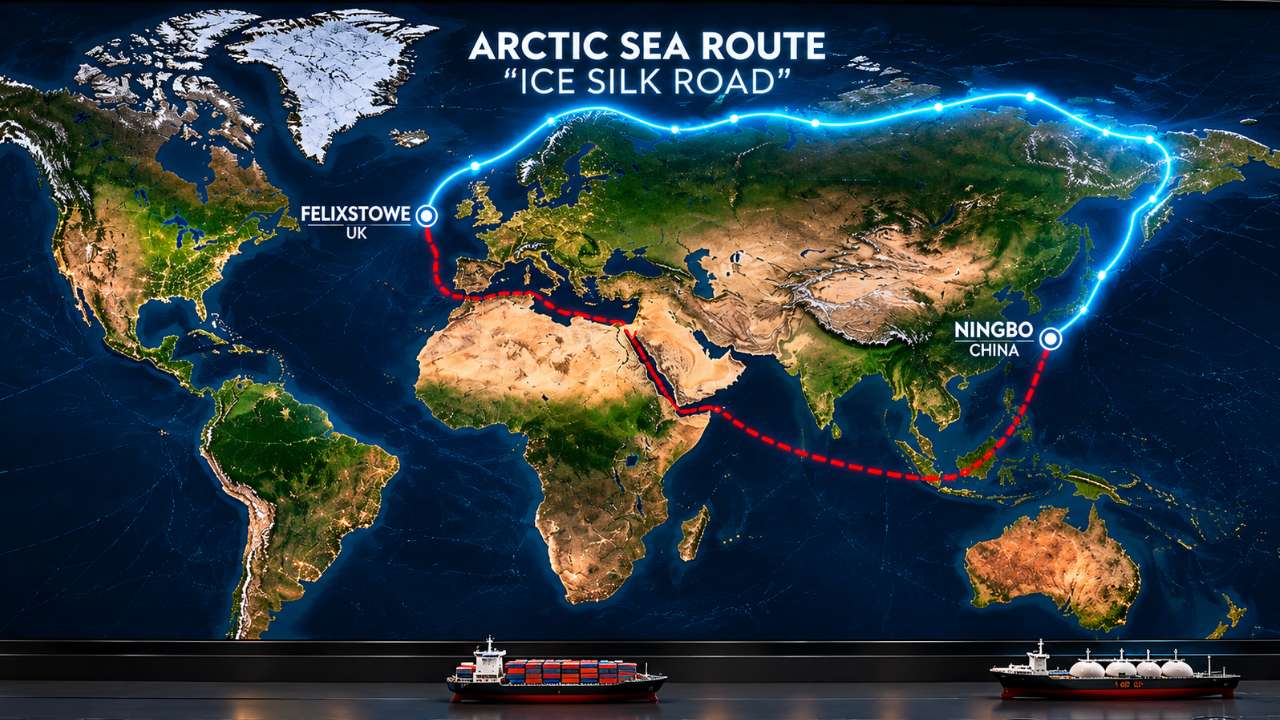
China Ice Silk Road
The recent escalation of geopolitical tensions in the Middle East and the growing insecurity in key sea lanes such as the Strait of Hormuz and the Bab al-Mandeb have severely disrupted international trade and global supply chains. The security risks in the Strait of Hormuz, which carries a large portion of the world’s oil and LNG trade, and the traditional Red Sea routes have forced shipping companies to look for alternative routes.
In light of these dire circumstances, China has formally launched an alternative and cutting-edge Arctic sea route to Europe, the ‘Ice Silk Road’. Starting from China’s eastern coastal trading city of Ningbo, through the northern regions of Russia, and crossing the Arctic to the UK’s Felixstowe port via the Northern Sea Route, this route has created a new wave in the global economy.
A test voyage by the Chinese container shipping company Sea Legend last year also gave positive indications about the potential of this route. According to the test, it takes only 18 to 20 days to transport goods from China to Europe via this route, which is about half the time compared to traditional sea routes.
This new Arctic sea route has the potential to have a number of significant benefits and positive impacts on global trade and economic activity. While the traditional Suez Canal takes more than 40 days, the Arctic route can be completed in about half the time, which can be a huge time saving.
This route can provide an alternative basis for trade security from geopolitical tensions, especially since it can bypass conflict-ridden areas and risky maritime checkpoints in the Middle East. In addition, due to the naturally cold environment of the Arctic region, this route is also expected to be useful for lithium-ion batteries, solar panels and other temperature-sensitive and fast-moving goods.
The shorter distance is expected to reduce fuel consumption and overall shipping costs and carbon emissions. However, the route is not entirely safe and secure. Due to sea ice and extreme weather, it is not open year-round and can only be operated as a seasonal alternative route during limited warm months.
Similarly, the lack of rescue and emergency facilities in the Arctic, the need for icebreaker support, and the risk of international sanctions and geopolitical tensions due to the Russian-controlled route are major challenges.
While it is unlikely that China’s Ice Silk Road will immediately become a complete alternative to the Suez Canal and completely change the traditional map of world trade, its impact on future geopolitical and commercial competition could be significant.
Malte Haupt, an analyst of Arctic shipping and founder of the Arctic Institute, a non-profit organization in Washington, D.C., said that Arctic sea routes offer the potential for alternative trade routes. According to him, this could address China’s limited control over strategic sea routes to some extent. He said the move is also a sign of growing economic cooperation between Russia and China.
China can ship goods to Europe via the Northern Sea Route, and it can also use it to ship oil to Asia. The ongoing conflict in the Middle East has made such an alternative route even more attractive.
According to Houpat, the unstable situation in the Strait of Hormuz and the Red Sea has encouraged some limited container operators to test using the Northern Sea Route.
However, the impact of climate change behind the expansion of the Arctic Sea Route cannot be ignored. According to the National Snow and Ice Data Center, all 17 of the lowest sea ice summers on record have occurred in the last 20 years. According to NASA, the extent of Arctic sea ice is also decreasing by about 12 percent per decade.
The shrinking sea ice is likely to increase ship traffic in the Northern Sea Route during the summer months. According to Anastasios Leonberg, a maritime risk consultant and former merchant ship captain, this means more accessible routes and longer, safer weather.
But the increasing shipping in the Arctic has also raised environmental concerns. According to environmental campaigners, black carbon from ship fuel could accelerate the melting of sea ice.
That is why the International Maritime Organization has banned the use of heavy fuel oil, a tar-like substance left over from the refining of cheap but high-energy crude oil, in the Arctic from 2024. However, some exceptions and legal loopholes remain in place.
The Oslo-based environmental watchdog and Bellona Foundation analyzed the voyage of a large Chinese cargo ship called the Istanbul Bridge through the Northern Sea Route last year. According to the organization’s analysis, the ship may not have been adequately built for operation in ice-covered seas, which could increase the risk of accidents. It also pointed out the possibility that it used heavy fuel oil.
Geopolitical tensions also make it unlikely that a new international agreement will be reached to regulate shipping in the Arctic. The rules of the Northern Sea Route are largely set by Russia. Environmentalists, however, worry that efforts to open the Arctic to global maritime trade without effective regulation and enforcement could seriously damage the sensitive ecosystem.
Thus, the short sea route made possible by the shrinking sea ice due to climate change, and the search for alternative routes due to ongoing instability in the Middle East, are making the Northern Sea Route even more strategically important. This has drawn the attention of the United States, European countries, and even NATO to the Arctic.
While there are serious concerns about the environmental impact of increased shipping in the Arctic, China’s Ice Silk Road signals a significant shift. The Arctic is no longer just a remote region covered in ice; it is emerging as a key hub for future global trade, energy supplies, maritime transport, and geopolitical competition.