
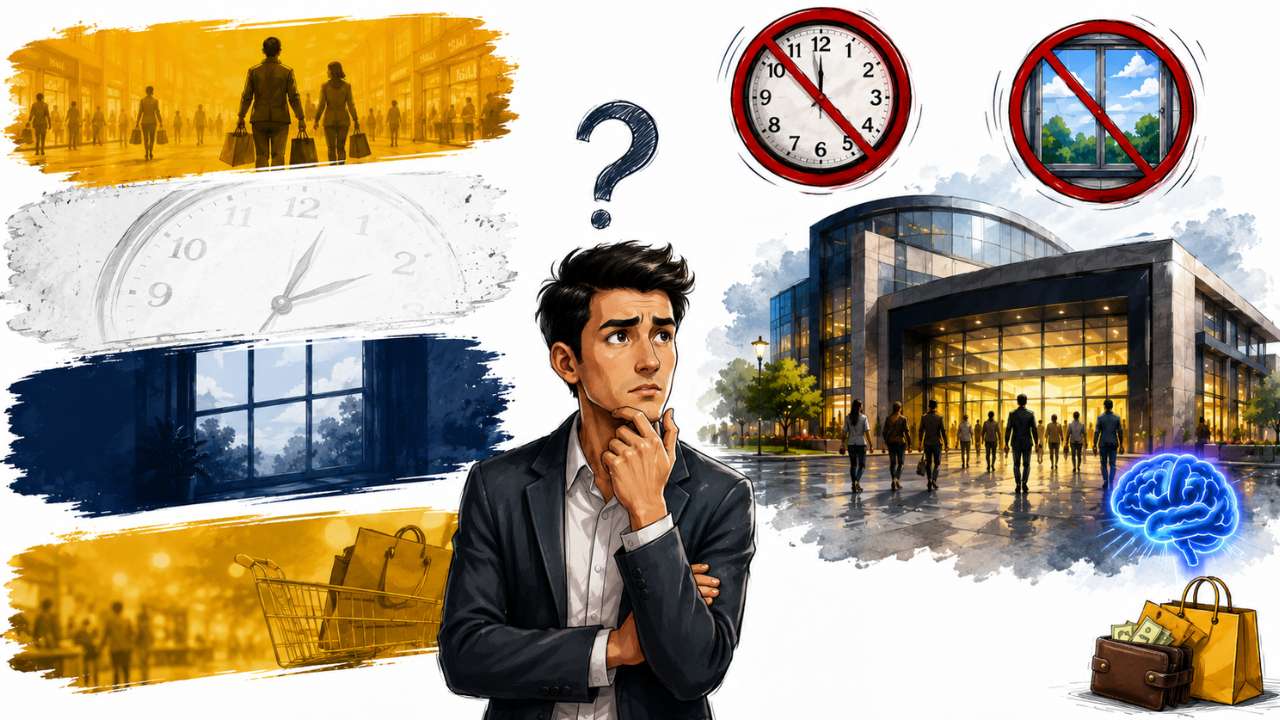
Why are there fewer clocks and windows in shopping malls? The psychology that makes you spend more money.
Why does a person who goes to a shopping malls to buy just a few items end up buying more than they planned and spending more time there? It’s not just about attractive stores and discounts. There is a deep connection between the design of the mall, lighting, music, scent, store layout, and customer behavior. Let’s understand this psychology of shopping malls.
Why are there fewer clocks and windows in shopping malls? The psychology that makes you spend more money
Have you ever noticed?
You enter a shopping mall with the intention of buying just a few things. Your plan is clear—buy the essentials and be back home in no time.
But when you come out, you have several shopping bags in your hand. Your wallet is lighter than before. You look at your mobile phone and realize—two or three hours have passed.
And a question may arise to you—
“How did so much time pass?”
What’s more interesting is that you don’t often see the clock while you’re inside the mall. In many places, the outside environment is also not clearly visible. Whether it’s sunny or dark outside, raining or the weather has changed—you may not know right away.
Is this just a coincidence of architecture and design?
In some cases, it is. But in the retail world, creating an environment that makes customers feel comfortable for a long time can also be an important strategy.
Today we’ll understand—how can the design of a shopping mall affect our perception of time, attention, and purchasing decisions?
Retail businesses don’t just sell goods
Most of us think that shopping is a simple process of buying the things we want.
But in the modern retail business, it is not limited to this.
Businesses also pay attention to how the customer experiences the store, where they stop, what products they see first, how long they spend there, and when they decide to buy.
This can be generally understood as a strategy to increase sales by understanding the behavior and psychology of the customer.
Because as the time a customer spends in a store or mall increases, the opportunity for him to see more products also increases.
And as more products are seen, the possibility of unplanned purchases can also increase.
This is why there is an important consideration in retail design—
Making the customer comfortable and making the in-store experience attractive.
Think of a small example
Let’s say you’re at a shopping mall to buy just one pair of shoes.
Your plan is—
“I will buy shoes and return home in 10 minutes.”
But once you enter the mall, the journey is not so simple. The first thing that catches your eye is an attractive coffee shop. A little further ahead, in large letters, it says—
“50% OFF”
Then a nice aroma comes from the perfume store. At the next turn, an electronics store appears. Then a clothing store. And a book store. Finally, a food court.
Even if you come to buy a pair of shoes, you have already been to five or six different places. You don’t even realize how much time has passed.
This can be an important objective of good retail design—to move customers seamlessly from one experience to another.
Why are clocks less visible in shopping malls?
Here’s an important point to make. There is no evidence that all shopping malls intentionally remove clocks. Many modern malls have clocks, and some even have a system that makes it easy for customers to see the time.
But in some indoor retail environments, time cues from the outside world may be less visible. The psychological effect of this can be interesting. Clocks are a constant reminder of the passage of time. If you look at a clock repeatedly, your brain might say—
“It’s been a long time, I have to go home.”
But when the time signal is low, you can focus on your surroundings for a while.
This is sometimes compared to a “Timeless Environment.”
But that doesn’t mean every mall has removed the clock to make customers forget about time.
The use of clocks or exterior views in mall design can vary for many reasons, including security, architecture, branding, natural lighting, energy efficiency, and customer experience.
Why are windows important?
Windows are not just for light and air. They connect us to the outside world. Imagine, you are shopping and suddenly you look out of a large window. It is already dark outside. Your brain can instantly estimate the time—
If you see it raining outside, you may decide to go home quickly. If you see the sun setting, you may also feel like time is passing.
But when you are completely indoors and there are fewer cues from the outside world, you may be able to focus on the mall environment for a while.
So some shopping malls may be designed to feel somewhat isolated from the outside world. But again—this is not a rule that applies to all malls.
Lighting can also influence customer behavior.
The lighting you see in a shopping mall is not just a common sight.
Lighting in a retail environment is used to help customers see products, create a comfortable environment, and draw attention to a specific space.
A too-dark environment can be uncomfortable. Too-bright lighting can also be uncomfortable. That’s why many stores choose lighting levels and colors based on the product and the environment.
This is why lighting styles vary in clothing stores, jewelry stores, restaurants, and electronics stores. Lighting isn’t just for lighting—it’s part of the customer experience.
Music can even influence your gait
Now let’s talk about music. While you’re shopping, you may not pay much attention to the song playing. But it does create an atmosphere. In a retail environment, the tempo, volume, and style of music can be linked to the customer experience.
For example, a very quiet environment can make customers feel relaxed, while music that is too loud or fast-paced can prompt some people to leave quickly.
So stores can choose music that is appropriate for their brand and their customers. The goal isn’t always to get customers to spend more.
But the customer experience in a store can be a critical part of sales.
Scent can also play a role
Now imagine—
You are walking through a mall. Suddenly, you smell fresh coffee. A little further on, you smell fresh bread from a bakery. As you approach the food court, you smell popcorn or other food.
These scents can grab our attention and activate positive memories and emotions associated with food.
This is why some retail and food brands use scent marketing, a strategy to create a brand experience through scent in their environments. But here too, one thing must be understood—scent does not have the same effect on everyone.
Why does the line to a store like IKEA take so long?
A good example of this is the layout of a large furniture store like IKEA.
There, the customer can experience moving through different departments and sample rooms, rather than just looking for one product and going straight to the cashier.
You might be looking for a table. But along the way, you see—a sofa, a lamp, kitchenware, storage boxes, a chair, decorative items.
And suddenly a thought might come to your mind—
“This could work at home too.”
This is where Impulse Buying can begin.
What is Impulse Buying?
Impulse Buying is a sudden decision to buy something that you didn’t plan on buying.
For example, you went to the shopping mall to buy a shirt. But as you approached the cashier, you saw a beautiful wallet. You didn’t need it. But the price wasn’t too expensive either.
You think—
“Let’s keep this too.”
And the item ends up in your bag. One such decision may seem small. But if thousands of customers make similar small decisions every day, it can turn into a big sale for your business.
Why is there chocolate near the cashier?
Now think of the checkout counter of a supermarket.
There you can often see such items—
- Chewing gum
- Chocolate
- Small snacks
- Batteries
- Small personal items
- Other low-value items
Why?
Because you have already bought the main items. You are standing in line. Your attention is free for a while. And then a small item comes in front of your eyes.
You think—
“Let me buy this small item.”
This small decision can be crucial for a retail business.
What does discount do to our brains?
Now comes one of the most powerful words—
DISCOUNT
“50% OFF”
“Buy 1 Get 1”
“Limited Offer”
“Today Only”
“Last Chance”
These words can immediately grab our attention.
Because the human mind can see a price drop as an opportunity. But here’s an important thing.
Seeing a discount doesn’t mean the item is cheaper.
If you didn’t need an item, even buying it at a 50 percent discount can be an extra expense for you.
For example, you bought an item worth $2,000 for . $1,000.
It may seem like you saved $1,000.
But if you didn’t need that item, you actually spent $1,000.
Understanding this difference is very important financially.
Do shopping malls intentionally make us spend more?
The answer is a bit complicated.
The general objective of a business is to increase sales by providing a good experience to the customer.
So, strategies like attractive design, good lighting, convenient layout, promotions, discounts, music and product display are used.
But this does not mean that the customer is forced to buy the goods.
The final decision is up to the customer.
The problem starts when we start buying continuously, going beyond our budget and plan.
So the question is not just—
“What is the mall doing?”
Another question is also important—
“How am I making my decisions?”
5 simple ways to save money while shopping
If you want to control your spending by understanding retail psychology, here are some simple rules you can follow.
- Make a shopping list
Make a list of the items you need before you go to the mall.
Think twice before buying items that are not on your list.
- Set a budget in advance
It is better to set a fixed budget than to have a “I’ll buy whatever I want” mentality.
For example—
“Today I will spend a maximum of $5,000.”
- Set a time limit
If you are going to the mall for just one task, give yourself a time limit.
This can reduce the chances of visiting different stores unnecessarily.
- Don’t make a quick decision after seeing a discount
Ask yourself three questions—
Do I need this?
Do I need this right now?
Would I buy this even if there was no discount?
If the answer to all three questions is “no,” it may be better to leave the item there.
- Use the “24-Hour Rule” to Stop Impulse Buying
Don’t buy something immediately when you see it as expensive or unnecessary.
If possible, think about it for 24 hours.
You can decide to buy the same item the next day only if you still need it.
Who ultimately has control?
Whether a shopping mall has a clock, windows, music, lighting, and scents can all influence our experience. But the final decision is ours.
Retail can shift our focus, time, and emotions into sales opportunities. We can control our money and our decisions.
So the next time you walk into a shopping mall, remember this—
The mall may tempt you to stay longer, but how long is up to you.
The mall may offer a lot of merchandise, but you decide which items to buy.
The mall may offer discounts, but you have to ask yourself if you really need those items.
Ultimately, financial prosperity isn’t just about making a lot of money.
Sometimes it’s just as important to understand where and why your money is being spent.
Because the difference between people who make money and people who save money is often not just about income.
The difference is—
In how much control they have over their focus, time, emotions, and decisions.
And perhaps that’s where real economic prosperity begins.