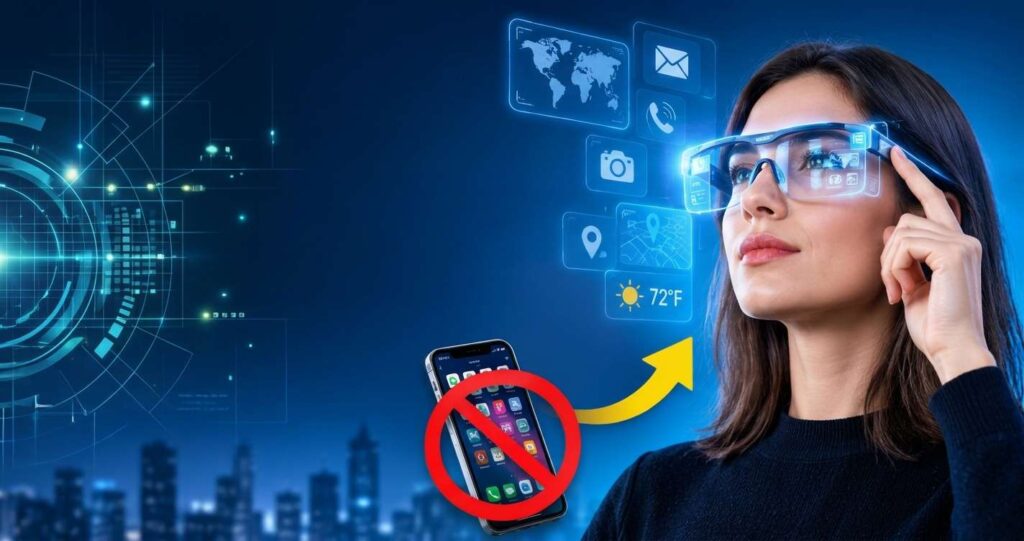
The first thing most of us touch in the morning isn’t a person. It’s the phone under the pillow. We silence the alarm, scroll the news, check our messages, maybe send some money, all before getting out of bed.
So when tech people started saying “the smartphone could come to an end,” it sounded like a stretch. But here’s the thing: the numbers coming out in 2026 are strange enough that the question deserves a real answer. Will smart glasses replace smartphones? Not tomorrow, and probably not entirely. But something is shifting, and it’s worth understanding before you spend money on your next device.
Key takeaways
- “The end of the smartphone” really means the end of its monopoly, not its disappearance.
- Smart glasses shipments grew by more than 250% in the first half of 2026, but they’re still a small market next to phones.
- Phones are under pressure for a surprising reason: memory chip shortages are pushing prices up and shipments down.
- Screenless AI gadgets have a rough record. The Humane AI Pin was shut down within a year of launch.
- Over the next five to ten years, expect phones plus new devices, not phones instead of them.
What does “the end of the smartphone” actually mean?
Nobody is predicting that one morning every phone will vanish. The real claim is smaller, and more interesting: the phone as the one device we stare at for hours may lose its central role.
Think about radio and television. When TV arrived, radio didn’t die. It just stopped being the thing the whole family gathered around. Phones could follow the same path. They swallowed the camera, the watch, the map and the radio. Now some of those jobs may drift back out to separate devices that do them more easily.
So the useful way to read the headline is this: the phone could stop being the device and become one of several. That’s a big change, even if no one throws their phone away.
Why is this being talked about now?
Four things are pushing the conversation.
1. Phones stopped feeling new. Put a phone from five years ago next to today’s and you’ll struggle to spot the difference. Better camera, brighter screen, longer battery. Useful, yes. Exciting, rarely. Companies know this, so they’re hunting for the next big category.
2. AI changed how we ask for things. You used to open an app, dig through menus and tap. Now you can just say, “Summarize this document” or “What’s the weather like tomorrow?” When talking works, the screen matters less. If you want to see how far this has come, our guide to the best AI assistants you can use today is a good place to start.
3. People are tired of screens. Anyone who has watched a whole family sit together, each lost in their own phone, knows the feeling. Interest in devices that keep your head up and your hands free is a direct reaction to that. (If you want to cut back yourself, try these practical screen-time habits.)
4. The phone market is under strain. This one is new, and it’s not what most older articles say. For years the story was “the market is saturated.” In 2026 it’s something harsher. According to IDC’s latest forecast, global smartphone shipments are expected to fall 16.7% this year to just over one billion units, as a memory chip shortage pushes the average price up by more than a quarter. Phones aren’t being beaten by a rival. They’re getting more expensive, and people are buying fewer of them.
What could take the smartphone’s place?
Experts mostly agree it won’t be one device. It’ll be a handful of them, each taking a slice of what the phone does today.
Smart glasses: the frontrunner
They look like ordinary glasses, but they carry a camera, speakers and an AI assistant. Some show directions or messages in your view. Others just talk to you. Either way, your hands stay free.
And people are buying them. A September 2026 report found smart glasses shipments grew by more than 250% in the first half of the year, with Meta’s Ray-Ban line far ahead of everyone else. Counterpoint Research data shows that almost all of that growth came from cheaper models without a built-in display. In other words, people are buying simple “AI glasses” that listen, talk and take photos, not sci-fi screens in their lenses.
Competition is coming too. Apple is rumored to be working on its own display-less glasses, with a launch reportedly targeted for 2027.
It’s worth keeping perspective, though. Fast growth from a small base is still a small base. If you’re curious about buying a pair, read our smart glasses buying guide first.
Smartwatches and earbuds
Quietly, these already do part of the job. With a watch on your wrist and earbuds in your ears, you can take calls, hear messages, play music and track your heart rate without pulling out your phone. Millions of people use them daily, which is exactly why they’re a believable path forward.
Screenless AI gadgets: a cautionary tale
Small pins and pendants with no display sound great on paper. In practice, the record is rough. The Humane AI Pin, a screenless wearable, launched with harsh reviews and was shut down in February 2025, less than a year after release. Owners found that the device stopped working once the company’s servers went offline.
The lesson is simple. A new gadget has to be clearly better than the phone you already own, not just different. And if a device depends on a single company’s servers, it can be switched off.
What could this mean for everyday people?
If it works, the biggest win is ease.
For older adults and first-time users. Apps can be confusing, and one wrong tap can feel risky. Saying “Call my son” or “How much money is in my account?” removes a lot of that fear.
For people whose language isn’t well supported. Many people struggle with English-only apps. If devices understand local languages well, and cost little, services like banking, health advice and government forms could reach places they never have. That’s a big “if,” and it depends on companies investing in more languages.
For students. Stuck on a hard lesson? Ask the AI to explain it in simpler words, right then.
For small business owners. Replying to customers, keeping accounts and tracking stock by voice could save hours every week.
What are the risks?
None of this comes free.
Privacy. A device that hears what you say, sees what you see and knows where you go knows a lot about you. Who stores that data, and who can buy it? Camera glasses also raise a fair question for everyone nearby: did you agree to be recorded? Our online privacy checklist covers the basics worth doing now.
Mistakes that are hard to undo. On a screen, you can see an error right away. By voice, an AI that mishears you could message or pay the wrong person, and fixing it may not be easy.
Cost and the technology gap. New gadgets start expensive. Until they get cheaper, people who can afford them gain the benefits and everyone else falls behind.
So, will the smartphone actually disappear?
Probably not anytime soon. History is on the side of the slow-change camp. Computers didn’t kill the typewriter overnight, and smartphones didn’t wipe out cameras and radios in a year. Old and new tech usually run side by side for a long time.
Most analysts expect phones to stay in our pockets for the next five to ten years, just with less of the spotlight. Big tech companies are pouring money into AI assistants and glasses, and whoever builds the easiest, most reliable option will lead the next era. In the end, though, the buyer decides. Hype doesn’t make a device last. Being genuinely useful does.
What should you do right now?
You don’t need to panic or rush to buy anything. A few sensible steps:
- If your phone works, keep it. There’s no prize for upgrading early, and phone prices are rising anyway.
- Start using AI assistants. It’s the easiest way to get comfortable with where things are heading.
- Guard your data. Review passwords, bank access and who can see your photos.
- Check before you buy. Look at price, security, battery life and whether it supports your language.
- Set screen-time limits for kids now, while habits are still forming.
And help the older people in your family learn these tools. Nobody should be left behind just because they learned technology later than the rest of us.
Frequently asked questions
Will smart glasses replace smartphones?
Not completely, and not soon. Smart glasses are growing fast, but they still depend on a phone for many tasks, and phones still sell in the hundreds of millions each year. The more realistic outcome is that glasses, watches and earbuds take over some everyday jobs, like directions, calls and quick questions.
Is the smartphone really going to end?
No, not in the sense of disappearing. What may end is the phone’s role as the only device we use for banking, learning, entertainment and communication.
What are the best alternatives to a smartphone today?
Smart glasses, smartwatches and wireless earbuds are the most practical options right now. Screenless AI pins and pendants are still unproven, and one major example, the Humane AI Pin, has already been discontinued.
Are smartphone sales really dropping in 2026?
Yes. IDC forecasts a steep decline in 2026, mainly because a memory chip shortage is raising component costs and phone prices.
Are smart glasses safe for privacy?
It depends on the model and your settings. Glasses with cameras and microphones collect data, so read the privacy policy, learn how recording is indicated, and be thoughtful about using them around other people.
Conclusion: look at it with curiosity, not fear
The smartphone won’t end in a day. It’ll fade from center stage slowly, as other devices take over what they do best. What people want hasn’t changed: something easy, safe and affordable.
So the real question isn’t which device we’ll hold in the future. It’s how much easier that device makes life, and how well it protects our private information. Stay curious, stay careful, and let the tech earn its place.
What do you think? Would you wear smart glasses all day, or is your phone staying in your pocket? Tell us in the comments, and explore more in our Technology section.