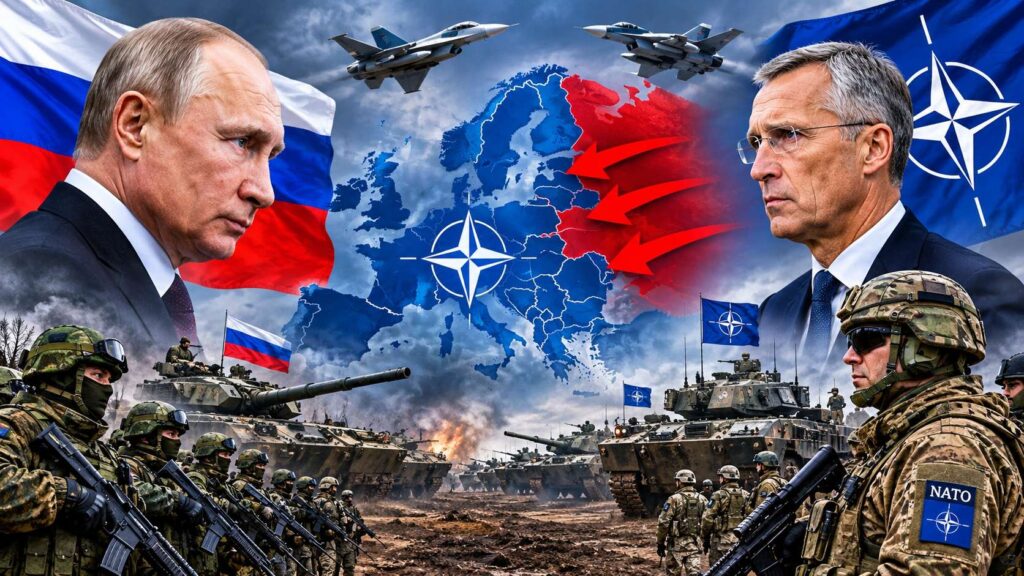
Growing tensions between Russia and NATO have raised concerns about the possibility of a direct military confrontation. Such a conflict could seriously jeopardise not only European security but also the political, economic and military order of the wider world.
A potential war could bring some of the world’s most powerful military forces into direct confrontation. However, its outcome would depend on military strategy, political decisions, geographical conditions and the international response.
A direct military confrontation between Russia and NATO would be unlikely to remain a regional conflict. Several important regions and strategic issues could shape its development, including the Baltic region, the Suwałki Corridor, Eastern Europe, air defence, nuclear deterrence, international trade and the global economy.
The Most Sensitive Frontline: The Baltic States
Estonia, Latvia and Lithuania are members of NATO, but their geographical position makes them particularly important to the alliance’s eastern defence strategy. The three countries share borders with Russia and Belarus, while Russia’s Kaliningrad exclave lies southwest of Lithuania.
Previous military exercises conducted by the RAND Corporation suggested that Russian forces could potentially reach the capitals of the Baltic States within a relatively short period under certain scenarios. However, NATO’s military presence, defence planning and regional capabilities have changed significantly. Those historical assessments should therefore not be treated as a definite prediction of the current military situation.
One possible Russian strategy could involve a fait accompli, creating a new military reality within a matter of days before NATO can organise an effective response.
To strengthen their defences, the Baltic countries are investing in border fortifications, obstacles, trenches and surveillance systems. Estonia, Latvia and Lithuania have also announced their withdrawal from the Ottawa Convention, which prohibits anti-personnel mines.
NATO’s Real Challenge: Moving Military Forces East
One of NATO’s biggest challenges in a potential conflict would be the rapid movement of troops and heavy military equipment across Europe.
According to German military planning scenarios, a major conflict could require the movement of approximately 800,000 soldiers towards NATO’s eastern flank within six months.
Transporting tanks, armoured vehicles and other military equipment from the United States would require an extensive logistical network involving ports, railways, roads, fuel supplies and military infrastructure.
Although military units can be deployed relatively quickly, moving and sustaining a much larger force is considerably more complicated.
The central question is therefore not simply how much military power NATO possesses, but how quickly that power could be mobilised and delivered to the frontlines.
Russian Submarines and the Atlantic Ocean
Another important area of concern is the North Atlantic, where Russian submarines could threaten NATO’s maritime operations and critical underwater infrastructure.
One strategically important location is the GIUK Gap, the maritime area between Greenland, Iceland and the United Kingdom. This passage is important for monitoring Russian naval movements between the Arctic and the Atlantic Ocean.
Russian submarines could potentially threaten military vessels, commercial shipping routes and undersea communication cables that carry a significant proportion of international internet traffic.
Such operations would not necessarily require the destruction of large naval vessels. Disrupting important maritime routes or damaging critical infrastructure could create serious logistical and economic problems for NATO countries.
For this reason, NATO could increase submarine detection operations, maritime patrols and protection of critical underwater infrastructure in the North Atlantic.
Fighter Jets in the Sky, Drones on the Battlefield
Air superiority would be another important factor in a potential Russia-NATO conflict.
Russia operates advanced fighter aircraft, including the Su-35 and Su-57, while NATO countries possess aircraft such as the Eurofighter Typhoon and the F-35.
The ability to control the skies could provide a significant advantage by allowing military forces to conduct air operations, protect ground troops and target enemy supply lines.
However, the war in Ukraine has demonstrated that modern warfare is not determined by fighter aircraft alone.
Relatively inexpensive drones have shown that they can damage or destroy extremely expensive military equipment, including tanks and armoured vehicles.
This development has changed military thinking about battlefield surveillance, air defence and the protection of ground forces.
The Challenges of Military Transportation Across Europe
Railways are among the most important transportation systems for moving heavy military equipment across Europe. However, several infrastructure problems could complicate NATO’s military mobilisation.
Germany’s railway network has faced concerns about ageing infrastructure, capacity limitations and maintenance requirements. These problems could create difficulties when large numbers of military vehicles and supplies need to be transported quickly.
Another challenge involves differences in railway track gauges. Most European countries use the standard railway gauge of 1,435 millimetres, while several railway networks in the Baltic region historically use the broader 1,520-millimetre gauge inherited from the Soviet period.
Such differences can complicate the movement of military equipment and require additional transportation arrangements.
The Suwałki Corridor: NATO’s Strategic Vulnerability
The Suwałki Corridor is one of the most strategically sensitive geographical areas in Eastern Europe.
Located along the border between Poland and Lithuania, this narrow stretch of land connects the Baltic States with the rest of NATO’s territory by land.
Russia’s Kaliningrad region lies to the northwest, while Belarus is located to the southeast. The corridor is approximately 65 kilometres wide at its narrowest point.
Its geographical position makes it particularly important in NATO’s defence planning. If this connection were disrupted during a conflict, transporting reinforcements and supplies to Estonia, Latvia and Lithuania could become more difficult.
Russia would not necessarily need to capture the entire corridor to threaten its use. Missile strikes, drone attacks, artillery threats or other military operations could potentially disrupt transportation and military movement.
What If the United States Does Not Provide Support?
One of the most important questions surrounding a possible Russia-NATO conflict concerns the role of the United States.
Under Article 5 of the NATO treaty, an armed attack against one member is considered an attack against all members. However, each member takes the action it considers necessary to assist the country under attack. This does not automatically require every country to respond with identical military action.
Political debates in the United States, including Donald Trump’s criticism of NATO defence spending, have raised questions in Europe about the future reliability of American military support.
If the United States reduced its military assistance during a major European crisis, other NATO members could face additional pressure to strengthen their own defence capabilities.
However, a major separation between the United States and European security arrangements could also create economic, political and strategic consequences for Washington.
The transatlantic relationship remains important to both sides, particularly in areas such as defence cooperation, international trade, intelligence sharing and global security.
Russia vs NATO: Who Would Win?
The question of who would win a war between Russia and NATO is difficult to answer because the outcome would depend on several unpredictable factors.
In terms of combined economic strength, technological resources and overall military capabilities, NATO has significant advantages over Russia.
However, military strength cannot be measured through numbers alone. Geography, military readiness, logistics, political unity, weapons systems and the decisions made during the early stages of a conflict could all influence the outcome.
Russia’s geographical position and military capabilities could create serious challenges for NATO, particularly in Eastern Europe. At the same time, NATO’s collective resources and military partnerships would make a direct confrontation extremely dangerous for Moscow.
Most importantly, both Russia and NATO possess nuclear weapons, making the risk of escalation one of the greatest concerns in any direct confrontation.
Global Consequences of a Russia-NATO War
A direct conflict between Russia and NATO could have consequences far beyond Europe.
- Global economy: Financial markets could experience severe instability and uncertainty.
- Energy supplies: Disruptions to oil and gas markets could increase energy prices.
- International trade: Shipping routes and supply chains could face major interruptions.
- Food security: Higher transportation and energy costs could increase food prices.
- Cybersecurity: Government systems, financial institutions and critical infrastructure could face cyberattacks.
- Nuclear security: Escalation between nuclear-armed powers could create catastrophic risks.
Conclusion: Could Russia and NATO Avoid a Direct War?
A direct war between Russia and NATO would be one of the most dangerous international security crises in modern history.
Even if one side achieved military objectives, the human, economic and political costs could be enormous. European security could be transformed, international trade could be disrupted and the global economy could face serious consequences.
However, such a conflict is not inevitable. Both sides understand the potentially devastating consequences of a direct military confrontation, particularly because of their nuclear capabilities.
The most important question is therefore not simply who would win a war between Russia and NATO, but whether both sides could prevent a crisis from escalating into a conflict that neither could fully control.
Frequently Asked Questions (FAQs)
1. What would happen if Russia and NATO went to war?
A direct war could trigger a major military confrontation in Europe, disrupt international trade, increase energy prices and create serious risks of nuclear escalation.
2. Which NATO countries are most exposed to Russia?
Estonia, Latvia, Lithuania, Poland and Finland are particularly important to NATO’s eastern defence planning because of their geographical proximity to Russia and Belarus.
3. What is the Suwałki Corridor?
The Suwałki Corridor is a strategically important area between Poland and Lithuania that connects the Baltic States to the rest of NATO by land.
4. Would the United States have to defend NATO members?
Article 5 establishes collective defence, but each NATO member determines the action it considers necessary to assist an attacked ally.
5. Is NATO militarily stronger than Russia?
NATO has a substantial advantage in combined economic resources, technological capabilities and overall military resources. However, the outcome of a war would depend on many operational and political factors.
6. Could a Russia-NATO war become nuclear?
Yes. Although nuclear escalation is not inevitable, a direct conflict between nuclear-armed powers could create a serious risk of escalation.